Why does paying something off in 6 to 12 months sound better than paying it in full now?
Is it because we think that in those 6 to 12 months, we are saving money? Is it because we feel that we are controlling when our money is being spent? Or is it because we feel guilty about spending that full amount now, so we decide to break it down to feel better about ourselves?
If you said yes to any of these, continue to read, you have just entered The Persuasion File.
Because here’s the twist: none of those feelings showed up by accident.
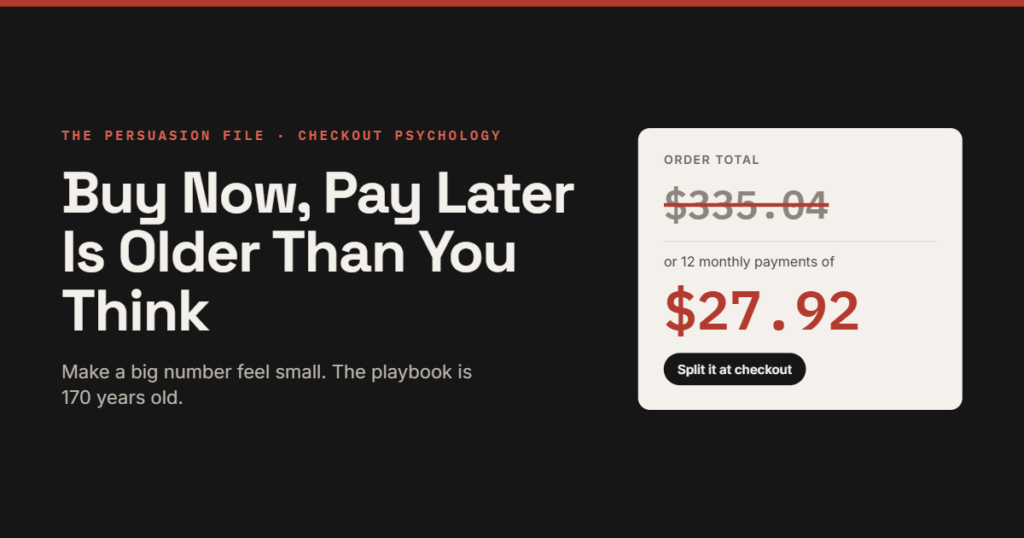
Seeing that $27.92 a month payment for something well over $300 is something that felt like a scam a couple years ago. Now? It looks like one of the greatest “deals” ever, and I’m not the only one who thinks this. Last year alone, $20 billion was spent using the Buy Now, Pay Later method during the holiday season. That’s 9.8% more than 2024, and for this year, it is on pace for a record-breaking number of $21.3 billion. Who created this payment method? How long have we been using this, and is this something that is beneficial not just to consumers, but to businesses too? Like with my previous articles, of course, psychologically speaking, it got me too.
Well, since we’re on the same page now… let’s go back to where everything first started. Or at least, where everyone says it started.
Buy Now, Pay Later Is Older Than You Think
Buy Now, Pay Later isn’t some new invention from the app era. It’s been around since the 1800s.
The oldest version of the story starts in 1807, a few blocks from where the Brooklyn Bridge stands today, at a Chatham Square furniture shop run by a chair maker named John K. Cowperthwait. Economists and reference books have credited his store, later Cowperthwait & Sons, as the birthplace of installment buying for nearly a century.
Here’s the catch: nobody has ever shown proof.
That 1807 claim first shows up in a 1903 pamphlet, with no source behind it, and it’s been copied ever since. When I dug through old New York newspapers, the earliest Cowperthwait ads I could find offering “weekly or monthly payments” were from the early 1870s. And when the founder’s grandson died in 1893, a trade magazine said he was the one who came up with the idea, not his grandfather.
So if Cowperthwait didn’t turn “pay a little at a time” into something the whole country knew… who did?
Let me explain.
The Lawyer and the Showman Who Sold the Sewing Machine
Back in the 1850s, it took 14 hours just to make a single shirt. Introduce the sewing machine, and now, instead of 14 hours, it only took 1 hour for that same shirt… Life-changing, right? Well, to get 13 hours of your life back, you will need to spend $100, and in a world where $500 was the average annual income for a family, this product wasn’t made for everyone… or was it?
To make matters worse, borrowing money wasn’t just something that was difficult to do back then, it was also something that was frowned upon. Banks weren’t lending money to everyday families, and back then, accumulating debt for something that did not earn you any money was looked at as irresponsible, even immoral.
So how could an average family afford this? Who had the solution to bridge the gap?
Enter Edward Clark, a New York lawyer and Isaac Singer’s business partner. Singer was the inventor behind I.M. Singer & Co., while Clark, who originally joined to handle Singer’s patent lawsuits, also handled marketing and advertising. Once Clark saw the problem with trying to sell a $100 sewing machine to families making $500 for the year, he realized that the product had to be sold in a different way for everybody. During this time, piano showrooms near Singer’s New York headquarters were already selling on installments. So, in 1856, instead of framing this new payment method as a loan, he decided that it should be framed as a rental. The customer would “hire” the machine, and each payment made would count towards the price, and only after the last payment was done, they would fully own the item. It has been reported that the initial terms were $5 as a down payment and then $3-$5 per month. With this in mind, the customers stopped thinking about their product as “$100 today”, instead it became more customer friendly, since now, it was advertised as “$5 today”.
Sound familiar?
While the price was right, the customers also had to be convinced that they were getting something back, since back then, society only accepted debt for things that earned them money. With this in mind, Singer’s justification for buying/renting the product was the amount of hours that people were going to save to create a shirt, from 14 hours to 1. That statement alone helped the buyers feel less guilty about using this method, since in return, they were getting the most important thing back, time. Smartly, they targeted these ads towards the housewife, who was the decision maker for the majority of the households. Within a year of launching the plan, their sales had roughly tripled. Clark also had salesmen go to clients’ living rooms to collect the money, however, as much as they were collecting money, they also spent this time to demo a machine and sell it to neighbors as well.
It has been noted by the Harvard Business School that Singer’s machines weren’t the best or the cheapest in the industry. However, the payment plan that they had was the difference maker. The sale of the machine also came with a service bundle, and a year later in 1857, Clark added the possibility to trade in an old or even a competitor’s machine towards a new Singer machine. By 1860, Singer was a millionaire, and the company’s aggressive salesmen and easy payments would soon take it worldwide. But, it wasn’t all good news. By the 1890s, “a dollar down, a dollar a week” was the line of hard-selling agents, and with a shady one, the payments could feel like they never ended.
The Influence For Years To Come
After Clark’s and Singer’s success with this Buy Now, Pay Later method, makers of pianos, organs, encyclopedias, and even stoves started selling the same way after the Civil War.
Fast forward 170 years, and instead of people coming door to door, this is something that can be achieved with a click of a button on any device you own.
Here’s how close the two really are:
Then vs. Now
| Singer, 1856 | Buy Now, Pay Later, today | |
|---|---|---|
| The pitch | Rent it. Every payment counts toward owning it. | Split it into easy payments. |
| The number you see | $5 down instead of $100 | $27.92 a month instead of $335.04 |
| How the guilt goes away | It pays for itself: a shirt takes 1 hour instead of 14 | It’s just smart budgeting |
| Where it happens | A salesman in your living room | A button at checkout |
| The catch | Hard-sell agents, and payments that never seemed to end | Late fees, and plans stacked on top of each other |
The pitch went from “it pays for itself” to “it’s only $X today,” but the idea being sold to us is the same: make a big number feel small, and make the guilt go away.
So… this takes us back to our first question: why does paying in 6-12 months sound better than paying in full?
Here’s the thing. It was never about saving money or being in control. And the guilt? That was real, but it wasn’t why you said yes. It was the one thing that was standing in between you and their sale, so they made it their mission to make the guilt disappear. It was always about making the big number look as small as possible.
Edward Clark figured that out in 1856. Your checkout page just does it faster.
The next time you see “6 payments of…” under a price, ask yourself this: is it actually more affordable? Or did someone study the psychology behind it and decide which number you’d be looking at?
p.s. there’s more 🙂
So, What Do You Do With This…?
Well, for businesses out there that are looking for ways to make their products available for everyone, Buy Now, Pay Later is not just a payment option. It’s ultimately your marketing decision.
A few things to know before using it:
- It works best when the price is the obstacle. $100 to a family making $500 a year is an obstacle. If your product isn’t a high-priced item, splitting into payments won’t be as sought after.
- Give customers a reason for it. Clark told people that “it paid for itself”. What will you tell your customer that this does for them? Do it without mentioning the price, instead, focus on the why.
- It isn’t free. Singer’s hard-sell era hurt the company’s reputation, and as consumers are being more awake to the late-payment numbers, it can ultimately cost you more in trust than in earned conversions.
Understanding the BNPL method isn’t about avoiding the “Pay in 6-12 months” forever. It’s so you can understand the why, and to either use this method at checkout, or at least understand why you should walk away from it, at your discretion of course.
This file is part of the Checkout Psychology series.
Sources
- Easy Payments: The Rise of Installment Selling — Harvard Business School, Baker Library
- Credit History: The Evolution of Consumer Credit in America — Federal Reserve Bank of Boston (2004)
- 2025 Holiday Shopping Report — Adobe (2026)
- 2026 Holiday Shopping Forecast — Adobe (2026)
- Installment Buying, Selling, and Financing — Dictionary of American History, via Encyclopedia.com
- Isaac Merrit Singer — Encyclopedia.com
- Cowperthwait & Sons Store, “The Oldest Furniture Business In America,” 1902 — Harlem World Magazine
- Martin Gregory Lecture, 1996 — International Sewing Machine Collectors’ Society
- Isaac Singer — Salem Press
- History Lessons from Singer Sewing Machines — Eugene Wei (2015)
- The “Fake” Instalment Business — Henry Raymond Mussey (1903), p. 12
- “Death of B. M. Cowperthwait” — The Carpet and Upholstery Trade Review, vol. 24, pp. 31–32 (1893)