Why does a $6 shipping fee feel like a scam, but $12 of extra stuff feels like a win?
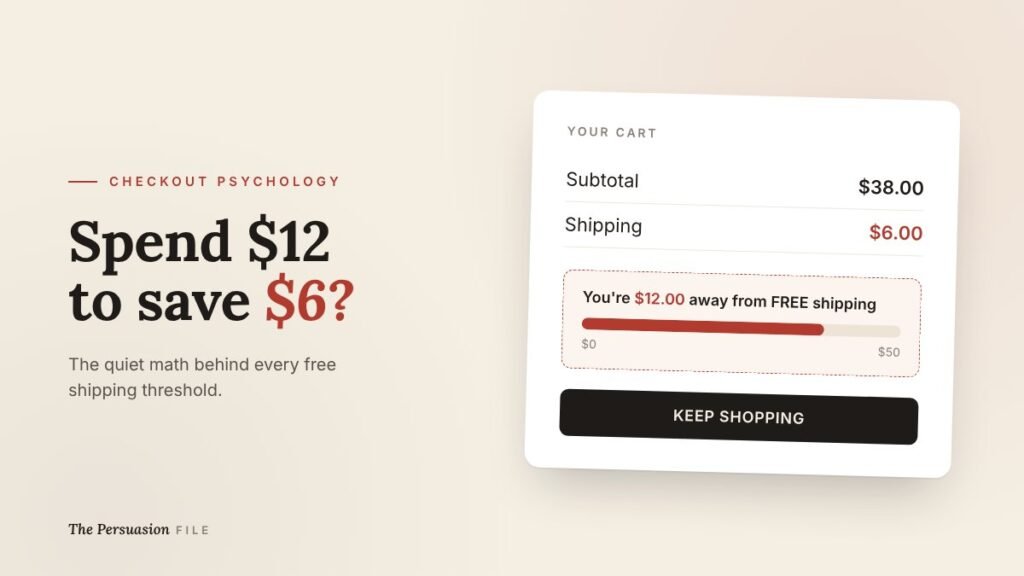
You know the moment. Your cart says $38. The banner at the top says “Free shipping on orders over $50.” And all of a sudden you’re scrolling through socks, phone chargers, and a candle you never needed – just to make that $6 disappear. Did you save money? Did you make the smart move? Or did someone build that banner knowing exactly what you’d do next?
If you’ve been there, continue to read, you have just entered The Persuasion File.
Because here’s the twist: you didn’t spend $12 to save $6 because you’re bad at math. You did it because your brain doesn’t treat the word “free” like a number at all.
And this is about to matter more. In Deloitte’s 2026 Global Retail Outlook, 67% of the 330 retail executives surveyed said they expect the free shipping threshold to go up. So that line you keep trying to cross? It’s moving.
The Free Shipping Threshold
A free shipping threshold is the minimum you have to spend before shipping costs nothing – the “free shipping on orders $50+” banner you’ve seen a thousand times. On paper, it’s simple. Psychologically, it’s one of the sneakiest tools on the entire checkout page, because it takes a fee you’d normally just pay and turns it into a goal you want to hit.
You’ve seen it everywhere. Target gives you free shipping once your order hits $35. Sephora sets the line at $50 – check out as a guest under that, and you’re paying $6.95 for shipping. Different store, different number, same feeling of “I’m almost there.”
Now you may be asking yourself, “why does a $6 fee bother me more than spending $12 extra?”, well… here’s why.
Why “Free” Hits Different
Researchers Kristina Shampanier, Nina Mazar and Dan Ariely tested this with chocolate. They set up a booth selling Lindt truffles for 15 cents and Hershey’s Kisses for 1 cent. Most people who bought something took the Lindt (73%) – better chocolate, better deal. Then they dropped both prices by one cent: Lindt at 14 cents, Hershey’s Kiss free. Same gap between the two. Same chocolate. And the choice flipped – 69% now took the free Hershey’s Kiss.
Nothing changed except one cent. What really changed was the word. They called it the zero-price effect: free doesn’t just feel cheaper, it feels like there’s no downside at all.
Now take that back to your cart. A $6 shipping fee is a loss you can see – you pay it and get nothing you can hold. $12 of extra stuff is… stuff. You get something for it. So your brain trades a pain for a purchase, and calls it a win.
I’ll tell you this: shoppers hate that fee more than almost anything else at checkout. The Baymard Institute puts the average cart abandonment rate at 70.22%, and the number one reason people walk away is extra costs – shipping, tax, fees – cited by 40% of shoppers who abandon. And in a Bizrate Insights and Digital Commerce 360 survey of 1,057 online shoppers, 73.9% picked free shipping as the delivery option that matters most – over speed, over everything.
And yes… psychologically speaking, it got me too.
Here’s What They Don’t Tell You
You’d think a business that offers free shipping is just eating the cost to make you happy. Not exactly.
Let me explain.
Researchers Michael Lewis, Vishal Singh and Scott Fay studied how shipping fees changed the way people shopped with an online retailer. Free shipping – and free shipping over a threshold – worked. It was very effective at generating additional sales. But here’s the part nobody puts on the banner: the shipping revenue the retailer gave up was big enough to make those promotions unprofitable.
So the threshold isn’t a gift. It’s a calculation. It’s set at the exact number where your extra $12 is supposed to cover the shipping they’re eating – and when costs go up, the number goes up with it. That’s the same Deloitte report again: retailers aren’t raising thresholds because free shipping stopped working on us. They’re raising them because it works so well, it got expensive.
And some brands found an even sneakier move. Sephora doesn’t make its Beauty Insider members hit $50 at all – members get free standard shipping with no minimum. Sounds generous, right? But joining means handing over your email and a record of everything you buy. The threshold didn’t disappear. They just stopped charging you in dollars.
Now, there are brands out there that skip the threshold completely – not because they can’t afford to charge for shipping, but because a “you’re $12 away” banner would work against them instead of for them.
Louis Vuitton lists standard delivery as complimentary for all orders. Chanel does the same. No minimum, no progress bar. Why? Because a luxury brand doesn’t want you digging around for a $12 add-on to unlock a perk – that’s discount-store behavior. And notice the word they use: not “free,” but “complimentary.” Free is a deal. Complimentary is a courtesy. At the end of the day, a luxury brand wants you to feel like you never had to think about shipping at all.
If you read my breakdown of the left-digit effect, you already know that a checkout page is built around where your eyes land. The threshold banner plays the same game, just with a different trigger – not the first digit, but the word “free.”
So, back to our first question – why did the $6 fee feel like a scam while the $12 felt like a win?
To tell you the truth, it was never about the money. You spent more to pay nothing, and it felt like saving. It all came down to one word sitting at the top of the page, doing more psychological work on you than the entire $50 cart combined.
And just like I told you earlier, this got me too – and not just at checkout. You’ll see the same zero-price effect in the “free” 7-day trial that quietly turns into a monthly charge, the “free gift with purchase” you didn’t know you wanted until it was free, the “buy one, get one free” that has you leaving with two of something you needed one of, and every “free returns” badge that makes it that much easier to say yes in the first place.
The next time you see “You’re only $12 away from free shipping,” ask yourself this: Am I saving $6? Or am I spending $12 so someone else can stop paying for my shipping?
p.s. there’s more 🙂
So, What Do You Do With This…?
Well, if you’re the one running the store – whether it’s an online shop, a subscription box, or a side hustle on Shopify – the free shipping threshold isn’t a perk. It’s a pricing decision.
A few things to know before using it:
- Set it just above where people already land. If most of your orders come in around $40, a $50 threshold is a nudge. A $100 threshold is a wall. Nobody adds $60 of stuff to save $6.
- Show the gap. “You’re $12 away from free shipping” turns a fee into a finish line. The closer the goal feels, the more likely someone is to chase it.
- Do the math first. As Lewis, Singh and Fay found, free shipping can drive sales and still lose you money. If the extra items don’t cover the shipping you’re eating, you’re paying people to shop.
Understanding this isn’t about refusing to ever hit that threshold again. It’s about understanding the why – so you can use it, or walk away from it, at your discretion.
This file is part of the Checkout Psychology series. For the full picture of how the final step shapes buying decisions, start with the Checkout Psychology guide.